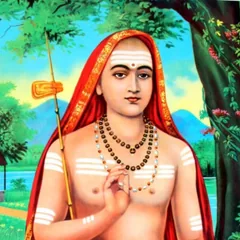
Adi Shankara
Adi Shankara Quotes about Knowledge
Just as a stone, a tree, a straw, grain, a mat, a cloth, a pot, and so on, when burned, are reduced to earth (from which they came), so the body and its sense organs, on being burned in the fire of Knowledge, become Knowledge and are absorbed in Brahman, like darkness in the light of the sun.
But the jiva [living being] is endowed with ego and his knowledge is limited, whereas Ishwar is without ego and is omniscient.
Self-Knowledge is the best of all forms of knowledge; it is the highest of all sciences, because through it one attains Immortality.
The fire of Knowledge reduces all works to ashes.
The man endowed with perfect Self-Knowledge is not entangled by his action; but the man devoid of this Knowledge enters samsara.
By the raft of Knowledge alone will you be borne over all sin.
The purity attained by the embodied being through the Knowledge of God is the supreme purity. The attainment of Self-Knowledge, by means of yoga, is the highest dharma.
The wise of olden times, endowed with firm resolution, spoke of Knowledge as the means to realize the Highest Good. Thus, by means of pure Knowledge, a man is liberated from all sins.
From a clear knowledge of the Bhagavad-gita all the goals of human existence become fulfilled. Bhagavad-gita is the manifest quintessence of all the teachings of the Vedic scriptures.
The twice-born (the brahmin) obtains the fulfilment of all desires through Self-Knowledge and not by any other means.
A man is bound by karma (action) and freed by Knowledge; therefore the far-seeing sannyasins do not engage in karma.
He obtains Immortality through Knowledge.