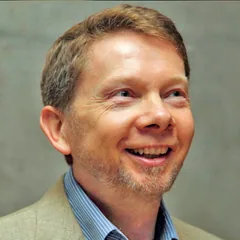
Eckhart Tolle
Eckhart Tolle Quotes about Ego
To the ego, the present moment hardly exists. Only past and future are considered important.
Ego is an immature stage of development for humans, and that's what it will be recognized as when the consciousness changes on the planet. Children will develop an ego and quickly outgrow it. That's very different from developing an ego and being stuck with it for the rest of your life.
The ego wants to want more than it wants to have.
With the egoic consciousness having become so dysfunctional, and now having at our disposal all these enormous technologies and scientific advances, if nothing changes the ego will use those things - as it already has been doing - and will amplify the technology that we now have. The scientific advances, to a large extent, will be used in the service of the ego, and they will become more and more destructive.
If you identify with a mental position, then if you are wrong, your mind-based sense of self is seriously threatened with annihilation. So you as the ego cannot afford to be wrong. To be wrong is to die. Wars have been fought over this, and countless relationships have broken down.
By far the greater part of violence that humans inflicted on each other is not the work of criminals or mentally deranged, but of normal, respectable citizens in service of the collective ego. One can go so far as to say that on this planet "normal" equals insane. What is it that lies at the root of this insanity? Complete identification with thought and emotion, that is to say, ego.
The word enlightenment conjures up the idea of some superhuman accomplishment, and the ego likes to keep it that way, but it is simply your natural state of felt oneness with Being. It is a state of connectedness with something immeasurable and indestructible, something that, almost paradoxically, is essentially you and yet is much greater than you. It is finding your true nature beyond name and form.
To the ego, loving and wanting are the same, whereas true love has no wanting in it, no desire to possess or for your partner to change.
The ego's form of happiness can't exist without unhappiness. The ego will be happy when something good happens but unhappy when it ends.
Ego means self-identification with thinking, to be trapped in thought, which means to have a mental image of "me" based on thought and emotions. So ego is there in the absence of a witnessing presence.
The ego wants to want more than it wants to have. And so the shallow satisfaction of having is always replaced by more wanting.
If you are content with being nobody in particular, content not to stand out, you align yourself with the power of the universe. What looks like weakness to the ego is in fact the only true strength. This spiritual truth is diametrically opposed to the values of our contemporary culture and the way it conditions people to behave.
The great arises out of small things that are honored and cared for. Everybody's life really consists of small things. Greatness is a mental abstraction and a favorite fantasy of the ego. The paradox is that the foundation for greatness is the honoring of small things of the present moment instead of pursuing the idea of greatness.
When someone becomes transparent, then something shines through that person that has nothing to do with the person or any of his or her personal history. What is required is becoming so transparent that the self or ego dissolves.
The moment you become aware of the ego in you, it is strictly speaking no longer the ego, but just an old, conditioned mind-pattern. Ego implies unawareness. Awareness and ego cannot coexist.
Wouldn't it be wonderful if you could spare them from all suffering? No, it wouldn't. They would not evolve as human beings and would remain shallow, identified with the external form of things. Suffering drives you deeper. The paradox is that suffering is caused by identification with form and erodes identification with form. A lot of it is caused by the ego, although eventually suffering destroys the ego-but not until you suffer consciously.
For the ego to survive, it must make time - past and future - more important than the present moment.