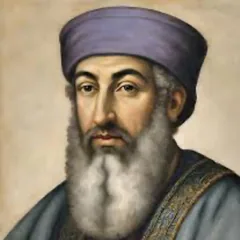
Maimonides
Maimonides Quotes about Existence
Know that the difficulties which lead to confusion in the question what is the purpose of the Universe or of any of its parts, arise from two causes: first, man has an erroneous idea of himself, and believes that the whole world exists only for his sake; secondly, he is ignorant both about the nature of the sublunary world, and about the Creator's intention to give existence to all beings whose existence is possible, because existence is undoubtedly good.
The Mutakallemim... apply the term non-existence only to absolute non-existence, and not to absence of properties. A property and the absence of that property are considered by them as two opposites, they treat, e.g., blindness and sight, death and life, in the same way as heat and cold. Therefore they say, without any qualification, non-existence does not require any agent, an agent is required when something is produced.
Now, we occupy a lowly position, both in space and rank in comparison with the heavenly sphere, and the Almighty is Most High not in space, but with respect to absolute existence, greatness and power.
God who preceded all existence is a refuge.
The question, "What is the purpose thereof?" cannot be asked about anything which is not the product of an agent; therefore we cannot ask what is the purpose of the existence of God.
This must be our belief when we have a correct knowledge of our own self, and comprehend the true nature of everything; we must be content, and not trouble our mind with seeking a certain final cause for things that have none, or have no other final cause but their own existence, which depends on the Will of God, or, if you prefer, on the Divine Wisdom.
The being which has absolute existence, which has never been and will never be without existence, is not in need of an agent.
It should not be believed that all beings exist for the sake of the existence of man. On the contrary, all the other beings too have been intended for their own sakes and not for the sake of anything else.
Even the existence of this corporeal element, low as it in reality is, because it is the source of death and all evils, is likewise good for the permanence of the Universe and the continuation of the order of things, so that one thing departs and the other succeeds.
The so-called evils are evils only in relation to a certain thing, and that which is evil in relation to a certain existing thing, either includes the non-existence of that thing or the non-existence of some of its good conditions.