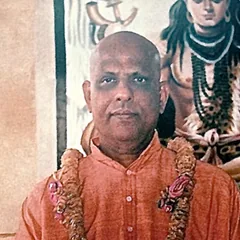
Swami Kripalvananda
Swami Kripalvananda Quotes about Yoga
The five yamas are: non-violence, truthfulness, non-stealing, brahmacharya and non-attachment. The five niyamas are: purity, contentment, study of the self, tapas (austerity) and surrender to God. The yamas and niyamas are the first two components of yoga’s eight integral components which are: yamas, niyamas, asanas, pranayama, pratyahara, dharana, dhyana and samadhi. Yoga sadhana can only be performed within the protective fortress of the yamas and niyamas. Without this foundation, the seeker is condemned to endless disturbances.
Whether the sadhaka wants to follow the path of jnana (knowledge), or the path of karma (action), the sadhaka must pass through the stage of action. Karma yoga is the base of all yogas. It is the first step and yoga of knowledge is the second step.
Without love, neither jnana yoga nor karma yoga can be fruitful. Love is the soul of yoga.
Study of the scriptures, devotion, and the execution of good works form the foundation of yoga. They count as the first step.
The path of yoga is so completely full of innumerable difficulties that the sadhaka who cannot fight against those difficulties with enthusiasm, faith, patience, and courage will never tread the yogic path.
Jnana yoga is understanding, bhakti yoga is love, and karma yoga is work done without attachment. The combination of these three is true yoga.
The meaning of yoga is samadhi.
There are countless asanas and mudras. Yet the ancient teachers have given predominance to only ten. They are: mulabandha, uddiyanabandha, jalandharbandha, mahamudra, mahavedha, mahabandha, viparitakarani, vajroli, shakticalana and khechari. These ten mudras are the immortal experiences of kriya yoga. A true yogi will certainly realize them through proper yoga sadhana.
A unique aspect of yoga sadhana is that the wholehearted practice of any one technique spontaneously elicits the entire spectrum of yogic techniques in a natural way. As a result, the initial stages of yoga prepare the groundwork for the more advanced stages.
Yoga is like a temple comprised of eight floors. Yama and niyama constitute the basement and ground floor, while asana, pranayama, pratyahara, dharana and dhyana constitute the first, second, third, fourth and fifth floors respectively. Savikalpa samadhi is the sixth floor and nirvikalpa samadhi is the seventh floor.
Yoga is known as Brahmavidya (knowledge of the supreme spirit). This great knowledge is ancient and extremely difficult to attain. For its accomplishment, many lifetimes are required. If it were evaluated objectively, it would be defined as the supreme religion, the global religion, the universal religion, the human religion or the eternal religion.
On the yogic path, various experiences occur which help increase the sadhaka’s faith, courage, knowledge, enthusiasm, devotion to his Guru, devotion to yoga, and finally his or her devotion to God. Initially, the sadhaka gains an understanding of the lower chakras; later the understanding of the middle; and finally understanding of the higher chakras unfolds. Besides this, the understanding or various asanas (postures), mudras (gestures), pranayama (breath control), pratyahara (withdrawal from sense objects) and jyoti darshana (vision of divine light) is accessible through experience. Thus the practice of yoga itself unfolds the knowledge of more advanced states of yoga.