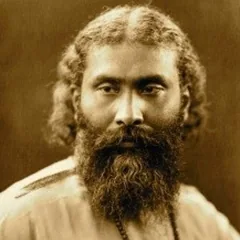
Hazrat Inayat Khan
Hazrat Inayat Khan Quotes about People
Very often pessimistic people speak against their own desire. They want to undertake some work, and they say, 'I will do this, but I don't think I shall succeed in it.' Thus they hinder themselves in their path. Man does not know that every thought makes an impression on the consciousness and on the rhythm with which the consciousness is working. According to that rhythm that reflection will come true and happen; and a man proves to be his own enemy by his ignorance of these things.
People who have never had an ideal may hope to find one; they are in a better state than the people who allow the circumstances of life to break their ideal. To fall beneath one's ideal is to lose one's track in life; then confusion rises in the mind, and that light which one should hold high becomes covered and obscured, so that it cannot shine out to light one's path.
We grown-up people think that we appreciate music, but if we realized the sense that an infant has brought with it of appreciating sound and rhythm, we would never boast of knowing music. The infant is music itself.
God is not justice. Justice is in his nature, but love is predominant. People attach such importance to actions and their results. They do not know that above action and result is a law which can consume the fire of hell, which can dominate even if the whole world were being drowned in the flood of destruction; they do not know that the power of love is greater than any other.
When people came to Christ accusing a person of doing wrong, the Master could not think of anything else but forgiveness. For he did not see in the wrongdoer what the others saw. To distinguish between right and wrong is not the work of an ordinary mind, and the curious thing is that the more ignorant a person is, the more ready he is to do so.
We, the human beings in this world, if there is a spark of goodness or kindness in our hearts, avoid judging people. We prefer forgiving to judging.
People often ask me questions that I cannot very well answer in words, and it makes me sad to think they are unable to hear the voice of my silence.
If people but knew their own religion, how tolerant they would become, and how free from any grudge against the religion of others.
I played the vina until my heart turned into the same instrument. Then I offered this instrument to the Divine Musician, the only musician existing. Since then I have become His flute, and when He chooses, He plays His music. The people give me credit for this music which, in reality, is not due to me, but to the Musician who plays His own instrument.
Some people look for a beautiful place, others make a place beautiful.
People have fought in vain about the names and lives of their saviors, and have named their religions after the name of their savior, instead of uniting with each other in the truth that is taught.
I had composed songs, I sang, and played the vina. Practising this music I arrived at a stage where I touched the music of the spheres. Then every soul became a musical note, and all life became music. Inspired by it I spoke to the people, and those who were attracted by my words listened to them instead of listening to my songs.
While people judge others from their own moral standpoint, the wise person looks also at the point of view of another.
Now if I do anything it is to tune souls instead of instruments. To harmonize people instead of notes. If there is anything in my philosophy, it is the law of harmony: that one must put oneself in harmony with oneself and with others.
People in the world wish to make things rigid, things which are of the finest nature which words cannot explain. When a person describes the hereafter, it is just like wanting to weigh the soul or photograph the spirit. I personally think that you must be able to realize yourself what the hereafter is. You must not depend upon my words.
The more one studies the harmony of music, and then studies human nature, how people agree and how they disagree, how there is attraction and repulsion, the more one will see that it is all music.
Music is the language of the soul; and for two people of different nations or races to unite, there is no better means than music.