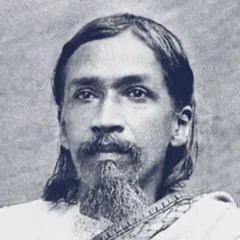
Sri Aurobindo
Sri Aurobindo Quotes about Mind
What is required is faith. Man has body, life and mind but that is not all that constitutes man. He has risen to the mind as a result of evolution. Now a higher consciousness will be evolved - this I call Supermind. It is the instrument of the Divine Consciousness, the Truth-Consciousness.
An active mind needs an outlet. If it stops by itself from within, well and good; otherwise one should not try to stop this by force.
I swore that I would not suffer from the world's grief and the world's stupidity and cruelty and injustice and I made my heart as hard in endurance as the nether millstone and my mind as a polished surface of steel. I no longer suffered, but enjoyment had passed away from me.
The human mind moves always forward, alters its viewpoint and enlarges its thought substance, and the effect of these changes is to render past systems of thinking obsolete or, when they are preserved, to extend, to modify and subtly or visibly to alter their value.
After having stopped the lower activities of the mind, it must be made receptive; and, instead of weaving all kinds of empty and idle thoughts, the mind should receive intuitions from above.
The supramental transformation, the supramental evolution must carry with it a lifting of mind, life and body out of themselves into a greater way of being in which yet their own ways and powers would be, not suppressed or abolished, but perfected and fulfilled by the self-exceeding.
Your mind has some clearness and capacity for right thinking; it opens towards the heights, but for its own sake, - to receive light from above for its own activity.
She saw the myriad gods, and beyond God his own ineffable eternity; she saw that there were ranges of life beyond our present life, ranges of mind beyond our present mind and above these she saw the splendors of the spirit.
Outside and above the mind there is the play of a consciousness which is lighted by the higher Truth, but man is not conscious of it and of that he has to be conscious.
It will not do to depend on the mind alone.
Spirituality is the master key of the Indian mind. It is this dominant inclination of India which gives character to all the expressions of her culture. In fact, they have grown out of her inborn spiritual tendency of which her religion is a natural out flowering. The Indian mind has always realized that the Supreme is the Infinite and perceived that to the soul in Nature the Infinite must always present itself in an infinite variety of aspects.
Spirituality is indeed the master-key of the Indian mind; the sense of the infinitive is native to it.
The psychic being and the mental being, Manomaya Purusha, are not the same. The psychic being is behind the mind, it is what the Westerners call the soul. It takes interest in the movements of the mind and the vital only when there is a harmony between these movements and the truth above. The knowledge of the psychic being is deeper.
That within us which seeks to know and to progress is not the mind but something behind it which makes use of it.
While doing work if the mind continues to be active let it be so, but there must be at the same time a capacity for silence.
The mind of an ordinary man is truly near the heart.
A quiet mind does not mean that there will be no thoughts or mental movements at all, but that these will be on the surface, and you will feel your true being within, separate from them, observing but not carried away
The subliminal mind receives and remembers all those touches that delight the soul. Our soul takes joy in this right touching by the Essence of all experience.
In order to satisfy the vital being, it must be offered some activity, and at the same time the mind should be slowly made to take interest in yoga.
Those who have advanced rise to the mind which is in the head, - they have the play of their mental movements in the head itself. But all these are inside the body; man is, as it were, shut up in a box, his entire consciousness is confined within the organism. This imprisonment has to be undone.
Sit in meditation! But do not think! Look only at your mind! You will see thoughts coming into it! Before they can enter, throw these away from your mind till your mind is capable of entire silence.
Not only a truer knowledge, but a greater power comes to one in the quietude and silence of a mind that, instead of bubbling on the surface, can go to its own depths and listen.
The consciousness of the supreme Purusha remains above, but in the mind there may be a Purusha consciousness which they call the cosmic consciousness - it is wide, all-pervading, one. Outside this goes on the play of Prakriti.
While doing sadhana you must quieten your mind and keep awake the Purusha consciousness behind all your activities.
Samskrit language, as has been universally recognized by those competent to form a judgment, is one of the most magnificent, the most perfect, the most prominent and wonderfully sufficient literary instrument developed by the human mind.