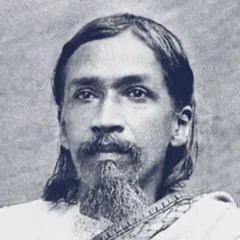
Sri Aurobindo
Sri Aurobindo Quotes about Yoga
The desire of your vital being is towards work. And the vital being won't find any interest in yoga so long as you do not have any experience of the higher and fuller life that is in yoga. As long as this experience is not there, the vital being will not find any interest.
Yoga is a generic name for any discipline by which one attempts to pass out of the limits of one's ordinary mental consciousness into a greater spiritual consciousness.
The principle of Yoga is the turning of one or all powers of our human existence into a means of reaching divine Being.
The yoga we practice is not for ourselves alone, but for the Divine; its aim is to work out the will of the Divine in the world, to effect a spiritual transformation and to bring down a divine nature and a divine life into the mental, vital and physical nature and life of humanity. Its object is not personal Mukti, although Mukti is a necessary condition of the yoga, but the liberation and transformation of the human being. It is not personal Ananda, but the bringing down of the divine Ananda - Christ's kingdom of heaven, our Satyayuga - upon the earth.
The higher Truth is all the time working in us but through the lower power - Aparashakti. It is when we become conscious of the play of this higher Power then only yoga begins.
The practice of Yoga brings us face to face with the extraordinary complexity of our own being.
In order to satisfy the vital being, it must be offered some activity, and at the same time the mind should be slowly made to take interest in yoga.
The one aim of [my] yoga is an inner self-development by which each one who follows it can in time discover the One Self in all and evolve a higher consciousness than the mental, a spiritual and supramental consciousness which will transform and divinize human nature.
Thus to act under the guidance coming from above, this is one side of the sadhana, the dynamic side. The other one is the discrimination between the Purusha and the Prakriti. The Purusha will calmly observe, give sanction, choose, but will realise that all this does not belong to him - all these are outside him. This is the static side of the sadhana. These two aspects constitute the basis of Yoga.