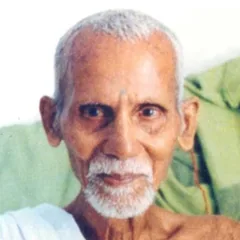
Swami Annamalai
Swami Annamalai Quotes about Consciousness
Go deeply into this feeling of 'I'. Be aware of it so strongly and so intensely that no other thoughts have the energy to arise and distract you. If you hold this feeling of 'I' long enough and strongly enough, the false 'I' will vanish, leaving only the unbroken awareness of the real, immanent 'I', consciousness itself.
When I say, 'Meditate on the Self' I am asking you to be the Self, not think about it. Be aware of what remains when thoughts stop. Be aware of the consciousness that is the origin of all your thoughts. Be that consciousness.
There is nothing wrong with looking at Bhagavan's picture. It is a very good practice. But you should not get sidetracked from your main objective, which is establishing yourself as consciousness. Don't get attached to states of bliss or give them priority over the quest for the Self.
Tayumanuvar, a Tamil saint whom Bhagavan often quoted, wrote in one of his poems: 'My Guru merely told me that I am consciousness. Having heard this, I held onto consciousness. What he told me was just one sentence, but I cannot describe the bliss I attained from holding onto that one simple sentence. Through that one sentence I attained a peace and a happiness that can never be explained in words.'
Mind is only a collection of thoughts and the thinker who thinks them. The thinker is the 'I'-thought, the primal thought which rises from the Self before all others, which identifies with all other thoughts and says, 'I am this body'. When you have eradicated all thoughts except for the thinker himself by ceaseless enquiry or by refusing to give them any attention, the 'I'-thought sinks into the Heart and surrenders, leaving behind it only an awareness of consciousness.
If you can maintain the siege for long enough, a time will come when no more thoughts arise; or if they do, they will only be fleeting, undistracting images on the periphery of consciousness. In that thought-free state you will begin to experience yourself as consciousness, not as mind or body.