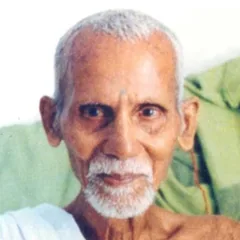
Swami Annamalai
Swami Annamalai Quotes about Thoughts
Remember that nothing that happens in the mind is 'you', and none of it is your business. You don't have to worry about the thoughts that rise up inside you. It is enough that you remember that the thoughts are not you.
Sadhana is a battlefield. You have to be vigilant. Don't take delivery of wrong beliefs and don't identify with the incoming thoughts that will give you pain and suffering. But if these things start happening to you, fight back by affirming, 'I am the Self; I am the Self; I am the Self;'. These affirmations will lessen the power of the 'I am the body' arrows and eventually they will armour-plate you so successfully, the 'I am the body' thoughts that come your way will no longer have the power to touch you, affect you or make you suffer.
Go deeply into this feeling of 'I'. Be aware of it so strongly and so intensely that no other thoughts have the energy to arise and distract you. If you hold this feeling of 'I' long enough and strongly enough, the false 'I' will vanish, leaving only the unbroken awareness of the real, immanent 'I', consciousness itself.
In a real fort the occupants need a continuous supply of food and water to hold out during a siege. When the supplies run out, the occupants must surrender or die. In the fort of the mind the occupants, which are thoughts, need a thinker to pay attention to them and indulge in them.
If the thinker witholds his attention from rising thoughts or challenges them before they have a chance to develop, the thoughts will all die of starvation. You challenge them by repeatedly asking yourself 'Who am I? Who is the person who is having these thoughts?' If the challenge is to be effective you must make it before the rising thought has had a chance to develop into a stream of thoughts.
When you have sealed off the mind in this way, challenge each emerging thought as it appears by asking, 'Where have you come from?' or 'Who is the person who is having this thought?' If you can do this continuously, with full attention, new thoughts will appear momentarily and then disappear.
When I say, 'Meditate on the Self' I am asking you to be the Self, not think about it. Be aware of what remains when thoughts stop. Be aware of the consciousness that is the origin of all your thoughts. Be that consciousness.
Bhagavan said that we should apply these same tactics to the mind. How to go about doing this? Seal off the entrances and exits to the mind by not reacting to rising thoughts or sense impressions. Don't let new ideas, judgements, likes, dislikes, etc. enter the mind, and don't let rising thoughts flourish and escape your attention.
The thoughts that come and go are not you. Whatever comes and goes is not you. Your reality is peace. If you don't forget that, that will be enough.
Continuous attentiveness will only come with long practice. If you are truly watchful, each thought will dissolve at the moment that it appears. But to reach this level of disassociation you must have no attachments at all. If you have the slightest interest in any particular thought, it will evade your attentiveness, connect with other thoughts, and take over your mind for a few seconds. This will happen more easily if you are accustomed to reacting emotionally to a particular thought.
Your ultimate need is to get established in the changeless peace of the Self. For this you have to give up all thoughts.
You have to keep up the enquiry, 'To whom is this happening?' all the time. If you are having trouble remind yourself, 'This is just happening on the surface of my mind. I am not this mind or the wandering thoughts.' Then go back into enquiry 'Who am I?'.
This surrender will only take place when the 'I'-thought has ceased to identify with rising thoughts. While there are still stray thoughts which attract or evade your attentoin, the 'I'-thought will always be directing its attention outwards rather than inwards. The purpose of self-enquiry is to make the 'I'-thought move inwards, towards the Self. This will happen automatically as soon as you cease to be interested in any of your rising thoughts.
There are so many thoughts in the mind. Thought after thought after thought. But there is one thought that is continuous, though it is mostly sub-conscious: 'I am the body'. This is the string on which all other thoughts are threaded. Once we identify ourselves with the body by thinking this thought, maya follows. It also follows that if we cease to identify with the body, maya will not affect us anymore.
However, if you relax your vigilance even for a few seconds and allow new thoughts to escape and develop unchallenged, the siege will be lifted and the mind will regain some or all of its former strength.
Mind is only a collection of thoughts and the thinker who thinks them. The thinker is the 'I'-thought, the primal thought which rises from the Self before all others, which identifies with all other thoughts and says, 'I am this body'. When you have eradicated all thoughts except for the thinker himself by ceaseless enquiry or by refusing to give them any attention, the 'I'-thought sinks into the Heart and surrenders, leaving behind it only an awareness of consciousness.
If you can maintain the siege for long enough, a time will come when no more thoughts arise; or if they do, they will only be fleeting, undistracting images on the periphery of consciousness. In that thought-free state you will begin to experience yourself as consciousness, not as mind or body.