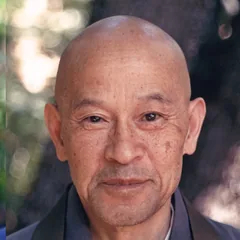
Shunryu Suzuki
Shunryu Suzuki Quotes about Practice
If your practice is good, you may become proud of it. What you do is good, but something more is added to it. Pride is extra. Right effort is to get rid of something extra.
So it is not a matter of whether it is possible to attain Buddhahood, or if it is possible to make a tile a jewel. But just to work, just to live in this world with this understanding is the most important point, and that is our practice. That is true zazen.
If you want to study Zen, you should forget all your previous ideas and just practice zazen and see what kind of experience you have in your practice. That is naturalness.
The secret of Soto Zen is just two words: not always so.... In Japanese, it's two words, three words in English. That is the secret of our practice.
Zazen practice and everyday activity are one thing. We call zazen everyday life, and everyday life zazen.
If enlightenment comes first, before thinking, before practice, your thinking and your practice will not be self-centered. By enlightenment I mean believing in nothing, believing in something which has no form or no color, which is ready to take form or color. This enlightenment is the immutable truth. It is on this original truth that our activity, our thinking, and our practice should be based.
When the restrictions you have do not limit you, this is what we mean by practice.
The practice of Zen mind is beginner's mind. The innocence of the first inquiry—what am I?—is needed throughout Zen practice. The mind of the beginner is empty, free of the habits of the expert, ready to accept, to doubt, and open to all the possibilities. It is the kind of mind which can see things as they are, which step by step and in a flash can realize the original nature of everything.
While you are continuing this practice, week after week, year after year, your experience will become deeper and deeper, and your experience will cover everything you do in your everyday life. The most important thing is to forget all gain ing ideas, all dualistic ideas. In other words, just practice zazen in a certain posture. Do not think about anything. Just remain on your cushion without expecting anything. Then eventually you will resume your own true nature. That is to say, your own true nature resumes itself.
If you understand real practice, then archery or other activities can be zen. If you don't understand how to practice archery in its true sense, then even though you practice very hard, what you acquire is just technique. It won't help you through and through. Perhaps you can hit the mark without trying, but without a bow and arrow you cannot do anything. If you understand the point of practice, then even without a bow and arrow the archery will help you. How you get that kind of power or ability is only through right practice.
Bowing is a very serious practice. You should be prepared to bow, even in your last moment. even though it is impossible to get rid of our self-centered desires, we have to do it. Our true nature wants us to.
In Zazen, in the practice of meditation, we do not try to escape from the world. We face it directly. By facing it directly, we can become completely immersed in it.
Let your ears hear without trying to hear. Let the mind think without trying to think and without trying to stop it. That is practice.
Even though you have pain in your legs, you can do it. Even though your practice is not good enough, you can do it.
If you think you will get something from practicing zazen, already you are involved in impure practice.
Our way is to practice one step at a time, one breath at a time, with no gaining idea.
You should rather be grateful for the weeds you have in your mind, because eventually they will enrich your practice.
People say that practicing Zen is difficult, but there is a misunderstanding as to why. It is not difficult because it is hard to sit in the cross-legged position, or to attain enlightenment. It is difficult because it is hard to keep our mind pure and our practice pure in its fundamental sense.
Our practice should be based on the ideal of selflessness. Selflessness is very difficult to understand. If you try to be selfless, that is already a selfish idea. Selflessness will be there when you do not try anything.
Zazen practice is the direct expression of our true nature. Strictly speaking, for a human being, there is no other practice than this practice; there is no other way of life than this way of life.
In the beginner's mind there is no thought, "I have attained something." All self-centered thoughts limit our vast mind. When we have no thought of achievement, no thought of self, we are true beginners. Then we can really learn something. The beginner's mind is the mind of compassion. When our mind is compassionate, it is boundless. Dogen-zenji, the founder of our school, always emphasized how important it is to resume our boundless original mind. Then we are always true to ourselves, in sympathy with all beings, and can actually practice.
The true practice to meditation is to sit as if you were drinking water when you are thirsty.
In your big mind, everything has the same value...In your practice you should accept everything as it is, giving to each thing the same respect given to a Buddha. Here there is Buddhahood.
If you continue this simple practice every day, you will obtain some wonderful power. Before you attain it, it is something wonderful, but after you attain it, it is nothing special.
We do not slight the idea of enlightenment, but the most important thing is this moment, not some day in the future. We have to make our effort in this moment. This is the most important thing for our practice.