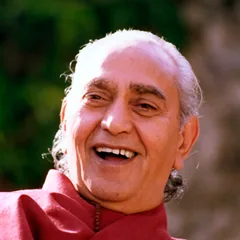
Swami Rama
Swami Rama Quotes about Mind
Meditation is not sitting and fidgeting, daydreaming, worrying, or fantasizing. It means watching, calmly observing the mind itself. Calm observation makes the mind itself calmer. The calmness of the mind creates power to go deeper and deeper into the beds of samskaras, into all the latent memories and impressions that daily provoke our habits and personalities. However, by calmly and very quietly going to the samskaras and observing them they are burnt away; they bubble to the surface and dissipate. This is the process of purification. It is a very powerful practice, and an essential one. Meditation is the exact method of becoming aware of who you are. It is the fundamental training for knowing your inner world.
Remember, you are not so miserable as you have made yourself out to be. You are God, too, and cultivating this constant awareness within you will help keep you from false attachments, from identifying yourself with your body, mind, and senses. So you must say to yourself, “Body, mind, and senses are mine, but they are not me, for I am that eternal flame which is not subject to change, death, and decay.” This awareness should always be with you.
Sushumna application is the most important factor in spiritual practice. The moment sushumna is awakened, the mind longs to enter the inner world. When the flow of ida and pingala is directed toward sushumna, and distractions are thereby removed, meditation flows by itself.
In my practice, when all the thoughts have gone through the mind, then I sit down and start to remember my mantra. Usually, you try to remember your mantra from the very beginning, and there are those thoughts waiting for your consultation, but you do not pay attention to them. Then, the thoughts are coming and going in your mind and you are trying to repeat your mantra, and the more the thoughts come, the more you repeat your mantra, and the result is an internal battle. That is not helpful; you do not need that.
Prayers are always answered; therefore, pray with all your mind and heart.
Spiritual practices, undertaken at an early age, have a profound and long-lasting effect. Human beings have tremendous potential provided they are taught to train themselves on all levels—physical, mental, and spiritual. Let us teach our children how to become aware of themselves on all levels. With a calm and one-pointed mind, children can obtain a glimpse of true peace and happiness.
A time comes when meditation stirs the unconscious mind and brings forward hidden impressions. It quickens the method of analyzing, understanding, and surveying the unconscious.
Many people think the mind can be controlled. That is not a useful idea. Like the monkey, the mind can never actually be controlled; it can only be directed. If you want to try to control your mind, you will regret the results. Forget the word "control" and learn to direct your mind and energy on all levels.
Every human being has potentials for healing. The healing energy is flowing without any interruption in every human heart. By the right use of the dynamic will, these channels of healing energy can be directed to the suffering part of the body and mind. The healing energy can nourish and strengthen the sufferer. The key to healing is selflessness, love, dynamic will, and undivided devotion to the Lord within.
The best of knowledge comes through revelation, not through the mind. It is a flood of knowledge that overwhelms the whole being.
Yoga is not a religion. It is not just a system of exercises to keep the body fit or to cure minor physical disorders. Yoga is a discipline for the fullest development of the soul, mind, and body. Yoga is a scientific, holistic approach to life.
Do not allow yourself to suppress your thoughts. Instead, let the thoughts come before you and become a sort of observer. Start observing your own mind. Do not try to escape; do not be afraid of your thinking.
One evening after my brother disciple and I had walked thirty miles in the mountains, we stopped to rest two miles beyond Kedarnath. I was very tired and soon fell asleep, but my sleep was restless because of my extreme fatigue. It was cold and I did not have a blanket to wrap around me, so I put my hands around my neck to keep warm. I rarely dream. I had dreamt only three or four times in my life, and all of my dreams had come true. That night I dreamt that the devil was choking my throat with strong hands. I felt as though I were suffocating. When my brother disciple saw my breath rhythm change and realized that I was experiencing considerable discomfort, he came to me and woke me up. I said, Somebody was choking my throat! Then he told me that my own hands were choking my throat. That which you call the devil is part of you. The myth of the devil and of evil is imposed on us by our ignorance. The human mind is a great wonder and magician. It can assume the form of both a devil and a divine being any time it wishes. It can be a great enemy or a great friend, creating either hell or heaven for us. There are many tendencies hidden in the unconscious mind which must be uncovered, faced, and transcended before one intends to tread the path of enlightenment.
The mind is prone to be reactionary if not trained, and an untrained mind creates disorder, disease, and confusion. If one does something with full attention, he will increase his awareness and ability to perform his duty. If one forms the habit of attending fully to whatever he is doing, the mind will become trained, and eventually concentration will become effortless.
When the senses are well-controlled and withdrawn from contact with the objects of the world, then sense perceptions no longer create images in the mind. The mind is then trained in one-pointedness. When the mind no longer recalls thought-patterns from the unconscious, a balanced state of mind leads to a higher state of consciousness. A perfect state of serenity established in sattva is the highest state of enlightenment. The practice of meditation and non-attachment are the two keynotes. A very firm conviction is essential for establishing a definite philosophy of life.
The breath is a bridge between body and mind.
Careful vigilance and observation lead the student to study the incoming thoughts from the unconscious mind. The yogis recall all their samskaras, watch them, examine, and even select and reject them according to their need. Those thought patterns that are disturbing are rejected by the yogis, and those that are helpful are strengthened. A deep study of these three states-waking, dreaming, and sleeping-reveals that, with the help and practice of yoga nidra, one can go beyond all the levels of the unconscious.
It is impossible to understand what exists through reasoning or intellectual debates. Absolute truth cannot be scientifically proven because it cannot be observed, verified, or demonstrated through sensory perceptions. (...) This is why scientists cannot come to any objective conclusion about the immortality of the soul and the afterlife, and in any case, nothing could convince them. (...) The objective world is only half of the universe. What we perceive through our senses is not the world in its entirety. The other half, which includes the mind, thoughts, and emotions, cannot be explained by sensory perceptions of external objects. (...) The soul has not been created. It is essentially consciousness and is perfect. After the dissolution of the gross body, everything remains latent. The soul survives.
Gurus impart the best of their knowledge in silence. When you are in silence, they communicate with you through silence, and in silence. For the student whose mind is in tune, that teaching is the finest of teachings. This silent communication can happen no matter where you are physically, whether you are 10,000 miles away or very close.
What good does it do to have all the riches of the world and all the world's pleasures? They will all disappear in the flash we call a human lifetime. Focusing on the pleasures of the world keeps the mind too distracted to search for the inner Self.
If you learn to go beyond the jabbering of your mind, and can go to the deeper aspects of your consciousness, then body, breath, and mind will not come in your way.
As long as the mind is outward, only ida and pingala remain active. But when the mind is calm and tranquil, sushumna, the central channel, is awakened. The joy derived from the mind traveling through the sushumna channel is unique; it cannot be compared with any sensory pleasure. Because of that inner joy, the mind loses its taste for worldly pleasures.
Those who are religiously sick believe in the existence of the devil by forgetting the existence of God. A negative mind is the greatest devil that resides within the human being. Transformation of the negativity leads toward positive or angelic visions. It is the mind which creates hell and heaven. Fear of the devil is a phobia which needs to be eradicated from the human mind.
To achieve purity of mind, one should cultivate constant awareness by being mindful all the time. One should remain always aware of one's thoughts.