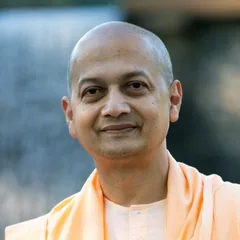
Swami Sarvapriyananda
Swami Sarvapriyananda Quotes about God
The great spiritual masters all seem to say that it’s God’s will alone—Thy will be done. It is God’s will which is working through everything, not ours.
The great disadvantage of a God-centered approach, especially in today’s world, is that the God-centered approach starts with—and proceeds with for a long time—faith. Belief. If you start with questioning and skepticism, it’s very difficult to follow the God-centered approach.
When I say that I am God, I mean all of us. When an enlightened person realizes that he or she is one with God, they realize that everybody is one with God.
All the Abrahamic religions are God-centered, theistic religions. And, because this is the only kind of religion that the West has been used to, they find something like Buddhism very confusing. How can you have a religion without God? Whereas in India it’s no problem at all. Buddhism has been there for 2500 years, Jainism even before that … In Buddhism, there is no talk about God. It’s openly agnostic. In Jainism, there is no talk about God.
When you know yourself truly as you are, you will know the reality … Our reality is the ultimate reality. God is our own reality. You are Brahman. This is the ultimate reality.
The Upanishads contain perhaps the most ancient living teachings on spirituality. Spirituality at its most original and fresh … The basic teaching of the Upanishads is that there is an ultimate reality—this world that we experience, and how we experience ourselves, are all manifestations of that reality. We are that reality. If only we would know ourselves truly, we would realize ourselves to be that absolute reality. That absolute reality in the Upanishads is called ‘Brahman.’ Brahman literally means ‘the vast’. That is the closest word you’ve got in Vedanta to God.
The God-centered religions/mentality is likely to be devotional: worship oriented, likely to be dualistic, likely to be temple/church/mosque oriented, likely to be ritualistic. In contrast, you will find the self-inquiry based religions tend to be: more monastic in nature, more of an inquiry, more intellectual, meditative rather than devotional, more meditation hall oriented rather than temple oriented.
What is Vedanta? Swami Vivekananda would say two things: the divinity within us, and the oneness of existence … Vivekananda used Advaita Vedanta as a foundation for morality. What Swami Vivekananda said was, because it is one reality, if I hurt somebody else, if I cheat somebody else, if I lie to somebody else, I am hurting myself in the deepest sense … Swami Vivekananda has said that he who runs away from the world to meditate and die in a Himalayan cave searching for God has missed the way. He who plunges headlong into the vanities of the world—he too has missed the way. Then what is the way? The way is to spiritualize your everyday life … We should realize ourselves as pure consciousness—Turiya—and everyone and everything as none other than the same Turiya, and live life in peace and fullness and joy. Realize the divinity within yourself and the spiritual oneness of the whole universe. Manifest that divinity in daily life through peace, love, and service to all beings. That is the spiritualization of everyday life.
That thou art. We don’t realize how radical that statement is. It means you are nothing other than God—which means you are not the body, you are not the mind, you are not even this little person. Even more stunning, God is nothing other than you.
Vedanta is a vast, vast literature. It’s an ancient tradition, 5000 years back to the Upanishads. And, yet you can describe Advaita Vedanta in one sentence: Tat Tvam Asi (That Thou Art) … ‘That’ meaning that which is worshipped as God, the reality behind this universe. ‘Thou’ meaning you the individual. You and that are the same thing … We investigate these two polarities … The analysis into who am I or what am I, and an analysis into what is God. Then you come to a synthesis: seeing that what is the reality beyond God and beyond individual.