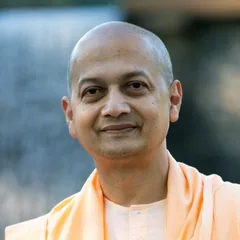
Swami Sarvapriyananda
Swami Sarvapriyananda Quotes about Vedanta
Descartes said, ‘I think, therefore I exist.’ Vedanta would go one step further. Even when I don’t think, I’m still aware of not thinking … Instead of saying, ‘I think, therefore I exist’, it would say, ‘I exist, therefore I think.’
That is the purpose of spirituality: to realize yourself as that Brahman … Vedanta says you and the other are not separate. You and the other are one reality.
Shankara’s commentary on the Brahma Sutra is the foundation of Advaita Vedanta, nondual Vedanta … ‘Nondual’ means apart from you—that real Self—there is no other thing. You are the only reality that exists. Apart from you, there is no second thing. If there is not two, a very interesting consequence is then everything that we see around you must be, in some sense, you only—not not apart from you … Consciousness is nondual meaning there is no second thing apart from consciousness … In you the consciousness, the entire universe is an appearance—not a second thing apart from you, hence you are that nondual consciousness … Oneness at the core expressed as the many—then what we have to practice is the harmony of the many.
To think that I am this waking body and mind, this person, is an error based on ignorance of Turiya, my real Self … You think of yourself as this person—this seems to be the indubitable truth for us. What Vedanta claims is if you investigate in this method of the waking, dreaming, and deep sleep, you will come across the real you—not this person but the witness of this person, the Turiya in which this person is arising, shining, and falling again.
The Upanishads contain perhaps the most ancient living teachings on spirituality. Spirituality at its most original and fresh … The basic teaching of the Upanishads is that there is an ultimate reality—this world that we experience, and how we experience ourselves, are all manifestations of that reality. We are that reality. If only we would know ourselves truly, we would realize ourselves to be that absolute reality. That absolute reality in the Upanishads is called ‘Brahman.’ Brahman literally means ‘the vast’. That is the closest word you’ve got in Vedanta to God.
Advaita Vedanta is one of the schools of Vedanta, but I would dare say it’s sort of preeminent because of certain reasons which make it peculiarly acceptable to the modern mind. There is little to no theology, and the emphasis is on experience and reason. Advaita Vedanta gives tremendous emphasis and importance to life as we experience it, and then uses reason to come to its conclusions … The conclusion of Advaita Vedanta was that we are, in a sense, profoundly mistaken about our own nature … Advaita’s purpose is to educate us, to shift our paradigm, so that we come to see the world and ourselves in that way.
Vedanta is talking about you. Your own reality. The Atman means the Self itself. Who am I? What am I? Right here, right now. Not a journey in space. Not a journey in time. Not a journey from one reality to another … Vedanta is not even a journey from one object to another.
What is Vedanta? It is the source of spiritual knowledge called the Upanishads … In a secondary sense, the texts themselves are called Vedanta. In a primary sense, the spiritual knowledge that we get from the Upanishads is Vedanta … If there is one text that is associated with Hinduism, it is the Bhagavad Gita … The Bhagavad Gita is basically the essence of the teachings of the Upanishads … These three—the Upanishads, the Bhagavad Gita, the Brahma Sutras—are together called the triple canon or the triple foundation of Vedanta.
The spiritual journey of Vedanta is not a journey in space. It’s not a journey from one place to another … Vedanta is not a journey in time. You are not waiting for something to happen … Vedanta is not there. It’s not then. It’s here and now.
Advaita Vedanta makes a clear distinction between mind and consciousness on the basis that mind is something that appears to consciousness. Therefore, consciousness is just that which illumines all objects … First-person experience is what consciousness does … From Advaita’s perspective, the definition of experience is ‘consciousness plus object.'
What is Vedanta? Swami Vivekananda would say two things: the divinity within us, and the oneness of existence … Vivekananda used Advaita Vedanta as a foundation for morality. What Swami Vivekananda said was, because it is one reality, if I hurt somebody else, if I cheat somebody else, if I lie to somebody else, I am hurting myself in the deepest sense … Swami Vivekananda has said that he who runs away from the world to meditate and die in a Himalayan cave searching for God has missed the way. He who plunges headlong into the vanities of the world—he too has missed the way. Then what is the way? The way is to spiritualize your everyday life … We should realize ourselves as pure consciousness—Turiya—and everyone and everything as none other than the same Turiya, and live life in peace and fullness and joy. Realize the divinity within yourself and the spiritual oneness of the whole universe. Manifest that divinity in daily life through peace, love, and service to all beings. That is the spiritualization of everyday life.
Vedanta is a vast, vast literature. It’s an ancient tradition, 5000 years back to the Upanishads. And, yet you can describe Advaita Vedanta in one sentence: Tat Tvam Asi (That Thou Art) … ‘That’ meaning that which is worshipped as God, the reality behind this universe. ‘Thou’ meaning you the individual. You and that are the same thing … We investigate these two polarities … The analysis into who am I or what am I, and an analysis into what is God. Then you come to a synthesis: seeing that what is the reality beyond God and beyond individual.