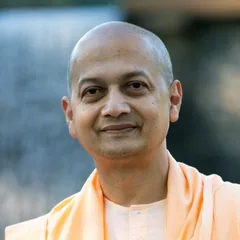
Swami Sarvapriyananda
Swami Sarvapriyananda Quotes about Mind
Sorrow is at the level of body and mind, and I am the unaffected witness of it … When the mind shuts down, the sorrow which it bears also goes away with the mind.
If you are Turiya, pure consciousness, you don’t have problems. If you have problems, then in some sense you’re still identified with the body and mind … Problems are always there in the three states, but in the one reality beyond the three states there is no problem … Realizing yourself as that, then live your life in the waking state, in the dream state, and in the deep sleep state—you are not affected by any of it.
To get stuck in a particular body, mind, and personality is ignorance. To step back from a particular body, mind, and personality into the background consciousness is enlightenment.
Beyond the mind, is no question of will. Will is within the mind, and being within the mind, it is a chain of cause and effect.
The good and the bad, the elevating and the demeaning, float past you in the stream of the mind. You are the consciousness sitting on the banks of the river of the mind watching.
I may act through the body and mind, but I am not under the error that I am the body and mind.
I am the mind, right? No, not really. How many times the mind has woken up in the morning, how many times the mind dreamt, how many times the mind slept—and you are the witness of all of them.
When we make this division that whatever you experience is an object, very soon we begin to see that the things we experience in the world ‘out there’ are objects but then our body is an object too … And, even more stunning, mind is an object—thoughts, feelings, emotions. Clearly objects come in two varieties: one is a publicly shared (what you can see around you), and one is the first-person private set of objects (memories, thoughts, pleasure, pain, the very personality itself).
Consciousness alone is the reality and that which we take to be the non-conscious—matter, time, space, bodies, this world—these are appearances in consciousness, not apart from consciousness. Just like a dream when you go to sleep and dream—all the things that you see in the dream have no existence apart from your own mind. In the same way, this entire universe which we experience has no existence apart from consciousness … There is no reasonable, logical answer within the dream for a dream.
In the ultimate reality, there is no question of will. What would the absolute will about? How would the absolute will anything? Willing is in the mind.
To think that I am this waking body and mind, this person, is an error based on ignorance of Turiya, my real Self … You think of yourself as this person—this seems to be the indubitable truth for us. What Vedanta claims is if you investigate in this method of the waking, dreaming, and deep sleep, you will come across the real you—not this person but the witness of this person, the Turiya in which this person is arising, shining, and falling again.
Advaita Vedanta is one of the schools of Vedanta, but I would dare say it’s sort of preeminent because of certain reasons which make it peculiarly acceptable to the modern mind. There is little to no theology, and the emphasis is on experience and reason. Advaita Vedanta gives tremendous emphasis and importance to life as we experience it, and then uses reason to come to its conclusions … The conclusion of Advaita Vedanta was that we are, in a sense, profoundly mistaken about our own nature … Advaita’s purpose is to educate us, to shift our paradigm, so that we come to see the world and ourselves in that way.
This entire world, body, mind, this person, and all other persons are all appearances in Me, the one consciousness.
Body-mind appearances appear in you, the consciousness, and they disappear within you. You, the consciousness, are the experiencer but ever unaffected.
Advaita Vedanta makes a clear distinction between mind and consciousness on the basis that mind is something that appears to consciousness. Therefore, consciousness is just that which illumines all objects … First-person experience is what consciousness does … From Advaita’s perspective, the definition of experience is ‘consciousness plus object.'
That thou art. We don’t realize how radical that statement is. It means you are nothing other than God—which means you are not the body, you are not the mind, you are not even this little person. Even more stunning, God is nothing other than you.