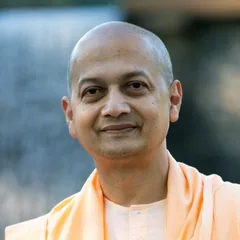
Swami Sarvapriyananda
Swami Sarvapriyananda Quotes about Thoughts
I am not a bundle of flesh and thought. I am consciousness to which appears this entire universe … Now, the subtle question is what are these objects which appear to us? Are they distinct, are they exterior to consciousness, or are they in some sense interior to consciousness? … Both the world and the body are experienced in thought, and thoughts are experienced in consciousness. When you pursue this line of thought, then the initial distinction which we made to appreciate ourselves as beings of pure consciousness, we begin to see not only consciousness but whatever consciousness is aware of—the entire external universe, the entire internal universe of thoughts and emotions—all of that is also not distinct from consciousness. It’s true that consciousness is distinct from everything it experiences and illumines, but that which it experiences and illumines is not actually distinct from consciousness because it’s just an abstraction to say that something exists outside consciousness.
When we make this division that whatever you experience is an object, very soon we begin to see that the things we experience in the world ‘out there’ are objects but then our body is an object too … And, even more stunning, mind is an object—thoughts, feelings, emotions. Clearly objects come in two varieties: one is a publicly shared (what you can see around you), and one is the first-person private set of objects (memories, thoughts, pleasure, pain, the very personality itself).
You are the witness of all your thoughts, and you are the witness of the absence of your thoughts too.