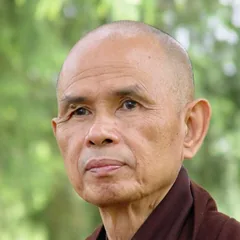
Thích Nhất Hạnh
Thích Nhất Hạnh Quotes about People
I am inviting you to go deeper, to learn and to practice so that you become someone who has a great capacity for being solid, calm, and without fear, because our society needs people like you who have these qualities, and your children, our children, need people like you, in order to go on, in order to become solid, and calm, and without fear.
Many people think excitement is happiness. But when you are excited, you are not peaceful. True happiness is based on peace.
Enlightenment is always there. Small enlightenment will bring great enlightenment. If you breathe in and are aware that you are alive—that you can touch the miracle of being alive—then that is a kind of enlightenment. Many people are alive but don't touch the miracle of being alive.
Some people live as though they are already dead. There are people moving around us who are consumed by their past, terrified of their future, and stuck in their anger and jealousy. They are not alive; they are just walking corpses.
People usually consider walking on water or in thin air a miracle. But I think the real miracle is not to walk either on water or in thin air, but to walk on earth. Every day we are engaged in a miracle which we don't even recognize: a blue sky, white clouds, green leaves, the black, curious eyes of a child -- our own two eyes. All is a miracle.
It never helps to draw a line and dismiss some people as enemies, even those who act violently. We have to approach them with love in our hearts and do our best to help them move in a direction of nonviolence. If we work for peace out of anger, we will never succeed. Peace is not an end. It can never come about through non-peaceful means.
From time to time, to remind ourselves to relax and be peaceful, we may wish to set aside some time for a retreat, a day of mindfulness, when we can walk slowly, smile, drink tea with a friend, enjoy being together as if we are the happiest people on Earth.
Anyone can practice some nonviolence, even soldiers. Some army generals, for example, conduct their operations in ways that avoid killing innocent people; this is a kind of nonviolence. To help soldiers move in the nonviolent direction, we have to be in touch with them. If we divide reality into two camps - the violent and the nonviolent - and stand in one camp while attacking the other, the world will never have peace. We will always blame and condemn those we feel are responsible for wars and social injustice, without recognizing the degree of violence in ourselves. We must work on ourselves and also with those we condemn if we want to have a real impact.
People have a hard time letting go of their suffering. Out of fear of the unknown, they prefer suffering that is familiar.
Do not avoid contact with suffering or close your eyes before suffering. Do not lose awareness of the existence of suffering in the life of the world. Find ways to be with those who are suffering by all means, including personal contact and visits, images, sounds. By such means, awaken yourself and others to the reality of suffering in the world. If we get in touch with the suffering of the world, and are moved by that suffering, we may come forward to help the people who are suffering.
If we do not know how to take care of ourselves and to love ourselves, we cannot take care of the people we love. Loving oneself is the foundation for loving another person.
We who have touched war have a duty to bring the truth about war to those who have not had a direct experience of it. We are the light at the tip of the candle. It is really hot, but it has the power of shining and illuminating. If we practice mindfulness, we will know how to look deeply into the nature of war and, with our insight, wake people up so that together we can avoid repeating the same horrors again and again.
Many people are alive but don't touch the miracle of being alive.
The main cause of your suffering is the seed of anger in you, because it has been watered too often, by yourself and by other people.
I have noticed that people are dealing too much with the negative, with what is wrong. ... Why not try the other way, to look into the patient and see positive things, to just touch those things and make them bloom?
If you look deeply into the palm of your hand, you will see your parents and all generations of your ancestors. All of them are alive in this moment. Each is present in your body. You are the continuation of each of these people.