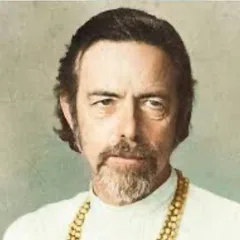
Alan Watts
Alan Watts Quotes about Past
We tend to regard ourselves as puppets of the Past, driven along by something that is always behind us.
There is only this now. It does not come from anywhere; it is not going anywhere. It is not permanent, but it is not impermanent. Though moving, it is always still. When we try to catch it, it seems to run away, and yet it is always here and there is no escape from it. And when we turn around to find the self which knows this moment, we find that it has vanished like the past.
The art of living... is neither careless drifting on the one hand nor fearful clinging to the past on the other. It consists in being sensitive to each moment, in regarding it as utterly new and unique, in having the mind open and wholly receptive.
If you insist on being determined by the past that's your game, but the fact of the matter is it all starts right now.
The past and the future are abstractions without any concrete reality.
Zen is a liberation from time. For if we open our eyes and see clearly, it becomes obvious that there is no other time than this instant, and that the past and the future are abstractions without any concrete reality.
Life is like music for its own sake. We are living in an eternal now, and when we listen to music we are not listening to the past, we are not listening to the future, we are listening to an expanded present.
We are living in a culture entirely hypnotized by the illusion of time, in which the so-called present moment is felt as nothing but an infinitesimal hairline between a causative past and an absorbingly important future. We have no present. Our consciousness is almost completely preoccupied with memory and expectation. We do not realize that there never was, is, nor will be any other experience than present experience. We are therefore out of touch with reality.
We think that the world is limited and explained by its past. We tend to think that what happened in the past determines what is going to happen next, and we do not see that it is exactly the other way around! What is always the source of the world is the present; the past doesn't explain a thing. The past trails behind the present like the wake of a ship and eventually disappears.
Nothing is more creative than death, since it has the whole secret of life. It means that the past must be abandoned, that the unknown cannot be avoided, that 'I' cannot continue, and that nothing can be ultimately fixed. When a man knows this, he lives for the first time in his life. By holding his breath, he loses it. By letting go he finds it.
The power of memories and expectations is such that for most human beings, the past and the future are not as real, but rather more real than the present.
I have realized that the past and future are real illusions, that they exist in the present, which is what there is and all there is.
If, then, my awareness of the past and future makes me less aware of the present, I must begin to wonder whether I am actually living in the real world.