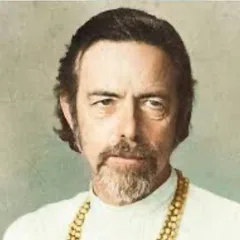
Alan Watts
Alan Watts Quotes about Time
To go out of your mind once a day is tremendously important, because by going out of your mind you come to your senses. And if you stay in your mind all of the time, you are over rational, in other words you are like a very rigid bridge which because it has no give; no craziness in it, is going to be blown down by the first hurricane.
Here is the vicious circle: if you feel separate from your organic life, you feel driven to survive; survival - going on living - thus becomes a duty and also a drag because you are not fully with it; because it does not quite come up to expectations, you continue to hope that it will, to crave for more time, to feel driven all the more to go on.
If you say that getting the money is the most important thing, you'll spend your life completely wasting your time. You'll be doing things you don't like doing in order to go on living, that is to go on doing thing you don't like doing, which is stupid.
I seem to be a brief light that flashes but once in all the aeons of time a rare, complicated, and all-too-delicate organism on the fringe of biological evolution, where the wave of life bursts into individual, sparkling, and multicolored drops that gleam for a moment... only to vanish forever.
The myths underlying our culture and underlying our common sense have not taught us to feel identical with the universe, but only parts of it, only in it, only confronting it - aliens... within I don't know how many years, but in not too long a time, it's going to become basic common sense that you are not some alien being who confronts an external world that is not you, but that almost every intelligent person will have the feeling of being an activity of the entire universe.
Zen is a liberation from time. For if we open our eyes and see clearly, it becomes obvious that there is no other time than this instant, and that the past and the future are abstractions without any concrete reality.
It takes time for an acorn to turn into an oak, but the oak is already implied in the acorn.
We are living in a culture entirely hypnotized by the illusion of time, in which the so-called present moment is felt as nothing but an infinitesimal hairline between a causative past and an absorbingly important future. We have no present. Our consciousness is almost completely preoccupied with memory and expectation. We do not realize that there never was, is, nor will be any other experience than present experience. We are therefore out of touch with reality.
Life and love generate effort, but effort will not generate them. Faith-in life, in other people, and in oneself-is the attitude of allowing the spontaneous to be spontaneous, in its own way and in its own time.
No one is more dangerously insane than one who is sane all the time: he is like a steel bridge without flexibility, and the order of his life is rigid and brittle.
There was never a time when the world began, because it goes round and round like a circle, and there is no place on a circle where it begins. Look at my watch, which tells the time; it goes round, and so the world repeats itself again and again.
The future is a concept, it doesn't exist. There is no such thing as tomorrow. There never will be, because time is always now. That's one of the things we discover when we stop talking to ourselves and stop thinking. We find there is only present, only an eternal now.
This present moment never comes to be and it never ceases to be, it is simply our minds that construct the continuity of thoughts we call time. In the present moment is nirvana.
Nothing is more creative than death, since it has the whole secret of life. It means that the past must be abandoned, that the unknown cannot be avoided, that 'I' cannot continue, and that nothing can be ultimately fixed. When a man knows this, he lives for the first time in his life. By holding his breath, he loses it. By letting go he finds it.
To the philosophers of India, however, Relativity is no new discovery, just as the concept of light years is no matter for astonishment to people used to thinking of time ins of kalpas, (A kalpa is about 4,320,000 years). The fact that the wise men of India have not been concerned with technological applications of this knowledge arises from the circumstance that technology is but one of innumerable ways of applying it.
We know that from time to time there arise among human beings people who seem to exude love as naturally as the sun gives out heat.
Time is a social institution and not a physical reality. There is no such thing as time in the natural world - the world of stars and waters, clouds, mountains and living organisms. There is such a thing as rhythm - rhythm of tides, rhythm of biological processes... There is rhythm and there is motion. Time is a way of measuring motion.
A person who thinks all the time has nothing to think about except thoughts. So he loses touch with Reality, and lives in a world of illusion.
We are living in a culture entirely hypnotized by the illusion of time.
That's a waste of time. If you really understand Zen... you can use any book. You could use the Bible. You could use Alice in Wonderland. You could use the dictionary, because... the sound of the rain needs no translation.
We are sick with fascination for the useful tools of names and numbers, of symbols, signs, conceptions and ideas. Meditation is therefore the art of suspending verbal and symbolic thinking for a time, somewhat as a courteous audience will stop talking when a concert is about to begin.
It's time to question a job or career move when it seems like most energy is devoted to making things appear other than what they really are.
What we see as death, empty space, or nothingness is only the trough between the crests of this endlessly waving ocean. It is all part of the illusion that there should seem to be something to be gained in the future, and that there is an urgent necessity to go on and on until we get it. Yet just as there is no time but the present, and no one except the all-and-everything, there is never anything to be gained - though the zest of the game is to pretend that there is.
Parts exist only for purposes of figuring and describing, and as we figure the world out we become confused if we do not remember this all the time.
Total situations are, therefore, patterns in time as much as patterns in space.