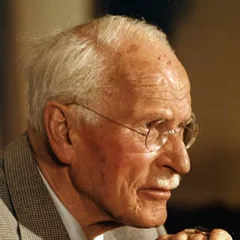
Carl Jung
Carl Jung Quotes about Life
In actual life it requires the greatest discipline to be simple, and the acceptance of oneself is the essence of the moral problem and the epitome of a whole outlook upon life.
The psychic depths are nature, and nature is creative life.
When a Pueblo Indian does not feel in the right mood, he stays away from the men's council. When an ancient Roman stumbled on the threshold as he left the house, he gave up his plans for the day. This seems to us senseless, but under primitive conditions of life such an omen inclines one at least to be cautious. When I am not in full control of myself, my bodily movements may be under a certain constraint; my attention is easily distracted; I am somewhat absent-minded. As a result I knock against something, stumble, let something fall, or forget something.
I have frequently seen people become neurotic when they content themselves with inadequate or wrong answers to the questions of life
Life is teleology par excellence; it is the intrinsic striving towards a goal, and the living organism is a system of directed aims which seek to fulfill themselves
The decisive question for man is: Is he related to something infinite or not? That is the telling question of his life.
The serious problems in life...are never fully solved. If ever they should appear to be so it is a sure sign that something has been lost. The meaning and purpose of a problem seem to lie not in its solution but in our working at it incessantly.
In the final analysis, we count for something only because of the essential that we embody. If we do not embody that, life is wasted.
When goals go, meaning goes. When meaning goes, purpose goes. When purpose goes, life goes dead on our hands.
Imagination is a concentrated extract of all the forces of life.
What happens in the life of Christ happens always and everywhere. In the Christian archetype all lives of this kind are prefigured.
I studiously avoided all so-called "holy men." I did so because I had to make do with my own truth, not accept from others what I could not attain on my own. I would have felt it as a theft had I attempted to learn from the holy men and to accept their truth for myself. Neither in Europe can I make any borrowings from the East, but must shape my life out of myself—out of what my inner being tells me, or what nature brings to me.
It was most essential for me to have a normal life in the real world as a counterpoise to that strange inner world. My family and my profession remained the base to which I could return.
The whole point of Jesus's life was not that we should become exactly like him, but that we should become ourselves in the same way he became himself. Jesus was not the great exception but the great example.
In the last analysis, the essential thing is the life of individual. This alone makes history, here alone do the great transformations take place, and the whole future, the whole history of the world, ultimately springs as a gigantic summation from these hidden source in individuals.
Man's unconscious... contains all the patterns of life and behaviour inherited from his ancestors, so that every human child, prior to consciousness, is possessed of a potential system of adapted psychic functioning.
Thoroughly unprepared, we take the step into the afternoon of life. Worse still, we take this step with the false presupposition that our truths and our ideals will serve us as hitherto. But we cannot live the afternoon of life according to the program of life’s morning, for what was great in the morning will be little at evening and what in the morning was true, at evening will have become a lie.
My whole being was seeking for something still unknown which might confer meaning upon the banality of life.
The greatest and most important problems of life are all fundamentally insoluble. They can never be solved but only outgrown.
Man positively needs general ideas and convictions that will give a meaning to his life and enable him to find a place for himself in the universe
There are as many archetypes as there are typical situations in life. Endless repetition has engraved these experiences into our psychic constitution, not in the forms of images filled with content, but at first only as forms without content, representing merely the possibility of a certain type of perception and action.
Life calls not for perfection, but for completeness.
It seems to be very hard for people to live with riddles or to let them live, although one would think that life is so full of riddles as it is that a few more things we cannot answer would make no difference. But perhaps it is just this that is so unendurable, that there are irrational things in our own psyche which upset the conscious mind in its illusory certainties by confronting it with the riddle of its existence.
I am astonished, disappointed, pleased with myself. I am distressed, depressed, rapturous. I am all these things at once, and cannot add up the sum. I am incapable of determining ultimate worth or worthlessness; I have no judgment about myself and my life. There is nothing I am quite sure about. I have no definite convictions - not about anything, really. I know only that I was born and exist, and it seems to me that I have been carried along. I exist on the foundation or something I do not know.
Our unconscious is the key to our life's pursuits.