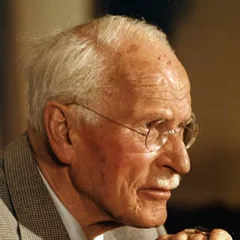
Carl Jung
Carl Jung Quotes about Nature
The psychic depths are nature, and nature is creative life.
Our intellect has created a new world that dominates nature, and has populated it with monstrous machines.
I studiously avoided all so-called "holy men." I did so because I had to make do with my own truth, not accept from others what I could not attain on my own. I would have felt it as a theft had I attempted to learn from the holy men and to accept their truth for myself. Neither in Europe can I make any borrowings from the East, but must shape my life out of myself—out of what my inner being tells me, or what nature brings to me.
Nature seemed to me full of wonders, and I wanted to steep myself in them. Every stone, every plant, every single thing seemed alive and indescribably marvelous. I immersed myself in nature, crawled, as it were, into the very essence of nature and away from the whole human world.
We are so full of apprehensions, fears, that we don't know exactly to what it points... a great change of our psychoglogical attitude is imminent, that is certain...because we need more understanding of human nature because ...the only real danger that exists is man himself... and we know nothing of man - his psyche should be studied because we are the origin of all coming evil.
Instinct is like Nature herself - prodigiously conservative, and yet transcending her own historical conditions in her acts of creation
The only thing that really matters now is whether man can climb up to a higher moral level, to a higher plane of consciousness, in order to be equal to the superhuman powers which the fallen angels have played into his hands. But he can make no progress until he becomes very much better acquainted with his own nature.
Dream analysis stands or falls with [the hypothesis of the unconscious]. Without it the dream appears to be merely a freak of nature, a meaningless conglomerate of memory-fragments left over from the happenings of the day.
Archetypes, in spite of their conservative nature, are not static but in a continuous dramatic flux. Thus the self as a monad or continuous unit would be dead. But it lives inasmuch as it splits and unites again. There is no energy without opposites!
Far from being a material world, this is a psychic world, which allows us to make only indirect and hypothetical inferences about the real nature of matter. The psychic, alone has immediate reality, and this includes all forms of the psychic, even
The facts of nature cannot in the long run be violated. Penetrating and seeping through everything like water, they will undermine any system that fails to take account of them, and sooner or later they will bring about its downfall. But an authority wise enough in its statesmanship to give sufficient free play to nature - of which spirit is a part - need fear no premature decline.
Fortunately, in her kindness and patience, Nature has never put the fatal question as to the meaning of their lives into the mouths of most people. And where no one asks, no one needs to answer.
It is just man's turning away from instinct--his opposing himself to instinct--that creates consciousness. Instinct is nature and seeks to perpetuate nature; while consciousness can only seek culture or its denial.
Every father is given the opportunity to corrupt his daughter's nature, and the educator, husband, or psychiatrist then has to face the music. For what has been spoiled by the father can only be made good by a father, just as what has been spoiled by the mother can only be repaired by a mother. The disastrous repetition of the family pattern could be described as the psychological original sin, or as the curse of the Atrides running through the generations.
Not nature, but the "genius of mankind," has knotted the hangman's noose with which it can execute itself at any moment.
It had become clear to me, in a flash of illumination, that for me the only possible goal was psychiatry. Here alone the two currents of my interest could flow together and in a united stream dig their own bed. Here was the empirical field common to biological and spiritual facts, which I had everywhere sought and nowhere found. Here at last was the place where the collision of nature and spirit became a reality.
The unconscious is not just evil by nature, it is also the source of the highest good: not only dark but also light, not only bestial, semihuman, and demonic but superhuman, spiritual, and, in the classical sense of the word, "divine."