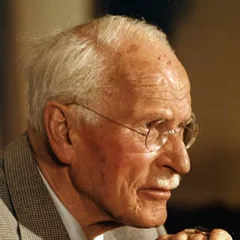
Carl Jung
Carl Jung Quotes about Unconscious
The squaring of the circle is a stage on the way to the unconscious, a point of transition leading to a goal lying as yet unformulated beyond it. It is one of those paths to the centre.
In the products of the unconscious we discover mandala symbols, that is, circular and quaternity figures which express wholeness, and whenever we wish to express wholeness, we employ just such figures.
It is only through the psyche that we can establish that God acts upon us, but we are unable to distinguish whether these actions emanate from God or from the unconscious. We cannot tell whether God and the unconscious are two different entities. Both are border-line concepts for transcendental contents. But empirically it can be established, with a sufficient degree of probability, that there is in the unconscious an archetype of wholeness.
Man's unconscious... contains all the patterns of life and behaviour inherited from his ancestors, so that every human child, prior to consciousness, is possessed of a potential system of adapted psychic functioning.
The greatest sin is to be unconscious.
The unconscious is the only available source of religious experience. This in certainly not to say that what we call the unconscious is identical with God or is set up in his place. It is simply the medium from which religious experience seems to flow. As to what the further cause of such experience might be, the answer to this lies beyond the range of human knowledge.
Dream analysis stands or falls with [the hypothesis of the unconscious]. Without it the dream appears to be merely a freak of nature, a meaningless conglomerate of memory-fragments left over from the happenings of the day.
Our unconscious is the key to our life's pursuits.
Much of the evil in the world is due to the fact that man in general is hopelessly unconscious.
The angel personifies something new arising from the deep unconscious.
Everyone carries a shadow, and the less it is embodied in the individual's conscious life, the blacker and denser it is. At all counts, it forms an unconscious snag, thwarting our most well-meant intentions.
If a union is to take place between opposites like spirit and matter, conscious and unconscious, bright and dark, and so on, it will happen in a third thing, which represents not a compromise but something new.
The difference between the "natural" individuation process, which runs its course unconsciously, and the one that is consciously realized is tremendous. In the first case, consciousness nowhere intervenes; the end remains as dark as the beginning. In the second case, so much darkness comes to light that the personality is permeated with light and consciousness necessarily gains in scope and insight. The encounter between conscious and unconscious has to ensure that the light that shines in the darkness is not only comprehended by the darkness, but comprehends it.
Until you make the unconscious conscious, it will direct your life and you will call it fate.
Water is the commonest symbol for the unconscious.
Unconscious assumptions or opinions are the worst enemy of woman; they can even grow into a positively demonic passion that exasperates and disgusts men, and does the woman herself the greatest injury by gradually smothering the charm and meaning of her femininity and driving it into the background. Such a development naturally ends in profound psychological disunion, in short, in a neurosis.
The collective unconscious contains the whole spiritual heritage of mankind's evolution born anew in the brain structure of every individual
The unconscious is not just evil by nature, it is also the source of the highest good: not only dark but also light, not only bestial, semihuman, and demonic but superhuman, spiritual, and, in the classical sense of the word, "divine."
The great problems of life — sexuality, of course, among others — are always related to the primordial images of the collective unconscious. These images are really balancing or compensating factors which correspond with the problems life presents in actuality. This is not to be marveled at, since these images are deposits representing the accumulated experience of thousands of years of struggle for adaptation and existence.